
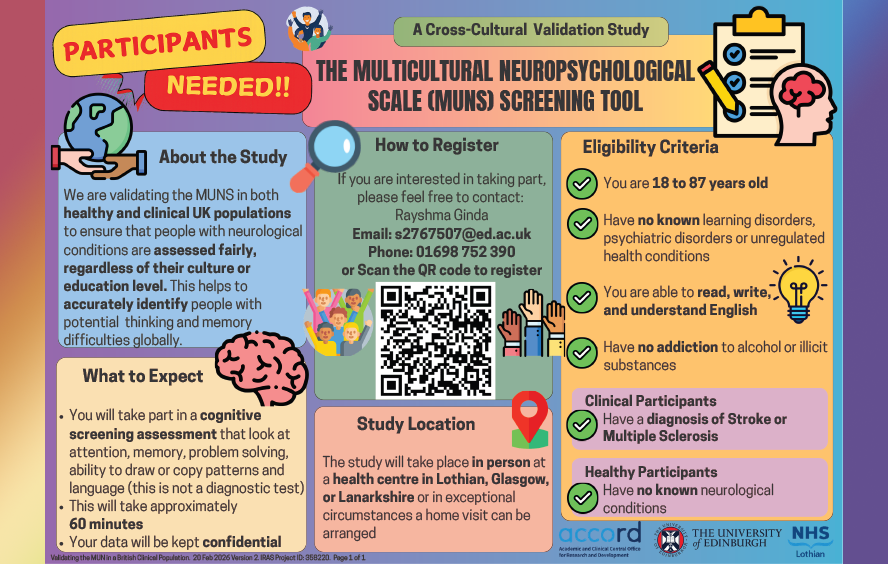
Researchers are testing the Multicultural Neuropsychological (MUNS) screening tool.
Researchers at the University of Edinburgh are seeking study participants to test the Multicultural Neuropsychological (MUNS) screening tool.
The aim of this study is to find out how well the English-version of the MUNS works for people living in the UK. The MUNS is a cognitive screening tool designed to be fair and accurate for people from different educational and cultural backgrounds. Its main goal is to reduce the chance of someone being wrongly identified as having cognitive problems when they do not.
Cognitive tests are often easier for people with higher levels of education. To make things fairer, the MUNS includes an adjustment based on reading level, which acts as an indicator of someone’s educational background.
In many parts of the world, access to cognitive tests—and the training needed to use them properly—is limited or too expensive. The MUNS is free to use, and free training is in development. This could make cognitive testing more accessible for people with neurological conditions, like stroke and multiple sclerosis (MS), in countries where resources are limited.
The researchers want to see whether the MUNS can accurately tell the difference between people with neurological conditions (such as MS or stoke) and people without these conditions.
The MUNS assesses how different parts of the brain are working, including:
• Attention
• Memory
• Problem-solving
• Visual-spatial skills (such as copying shapes or patterns)
• Language
By taking part, you will be helping research that aims to improve how cognitive screening assessments are used in multicultural healthcare settings—supporting a fairer, more accurate approach for everyone.
The researchers are looking for healthy participants and clinical paricipants.
a) Healthy Participants
· You are 18 to 87 years old
· Have no known neurological conditions (such as Parkinson’s disease, Huntington’s disease, human immunodeficiency virus, dementia, epilepsy, multiple sclerosis, stroke, traumatic brain injury, mild cognitive impairment, coma)
· Have no known learning disorders (learning disability, dyslexia, dyscalculia, attention deficit disorder)
· Have no known psychiatric disorders (such as an anxiety disorder, major depressive disorder, schizophrenia, personality disorders, post-traumatic stress disorder)
· Have no known severe/unregulated health conditions (such as non-treated thyroid disease, non-treated high blood pressure, severe cardiac failure, severe sleep disorders)
· You are able to read, write and understand English
· The ability to abstain from alcohol and illicit substances during the assessment period.
· Have no current addiction to illicit substances or alcohol (addiction defined as taking more of the substance and for a longer period of time than intended; unsuccessful attempts to reduce or stop use; spending a lot of time obtaining, using, or recovering from use; and craving the substance).
b) Clinical Participants
· You are 18 to 87 years old
· Have a neurological condition (multiple sclerosis or stroke)
· Individuals with stroke are more than one-month post-stroke, not currently an in- patient at hospital, do not have aphasia, do not have left- or right-sided neglect, and do not have one-sided weakness in your dominant hand
· Have no known learning disorders (learning disability, dyslexia, dyscalculia, attention deficit disorder)
· Have no known psychiatric disorders (such as an anxiety disorder, major depressive disorder, schizophrenia, personality disorders, post-traumatic stress disorder)
· Have no known severe/unregulated health conditions (such as non-treated thyroid disease, non-treated high blood pressure, severe cardiac failure, severe sleep disorders)
· You are able to read, write and understand English
· The ability to abstain from alcohol and illicit substances during the assessment period.
· Have no current addiction to illicit substances or alcohol (addiction defined as taking more of the substance and for a longer period of time than intended; unsuccessful attempts to reduce or stop use; spending a lot of time obtaining, using, or recovering from use; and craving the substance).
For more information please contact Rayshma Ginda.
Email: [email protected]
Phone: 01698 752390